
UK Chapter IPv6 Matrix Project
Author
Olivier Crépin‑Leblond, PhD
Internet Society United Kingdom Chapter
IPv6 Matrix Project
Date of Issue
15 August 2026
Latest Dataset Used
3 August 2026 IPv6Matrix Crawl
(Majestic Million top 1,000,000 domains)
Table of Contents
2. Website Host Records — August 2026.
- 2.1 Protocol Distribution.
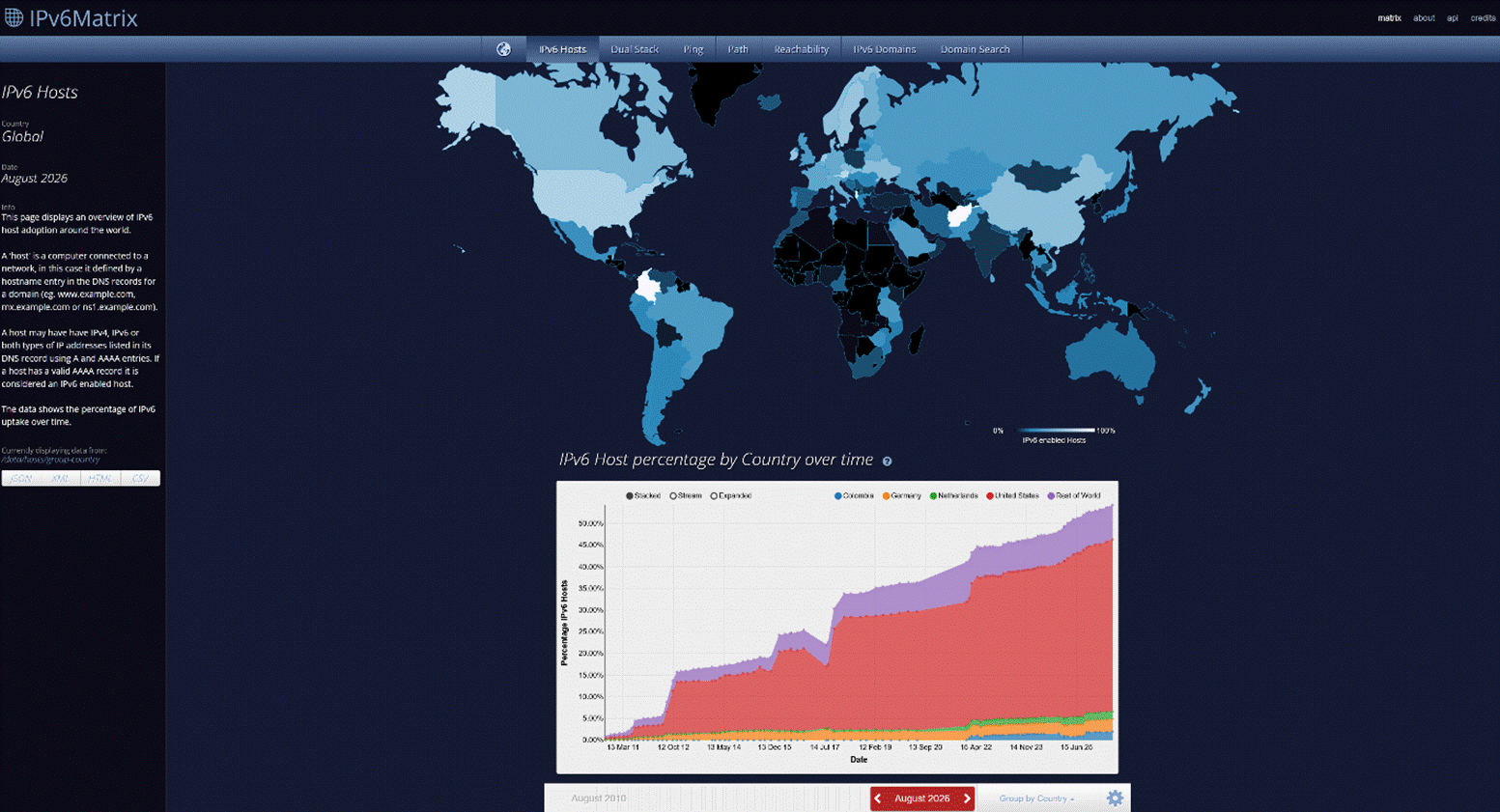
- 2.2 Adoption Trajectory: 2010 – August 2026.
- 2.3 IPv4-Only Hosts at Record Low..
3. Host Reachability (May 2026)
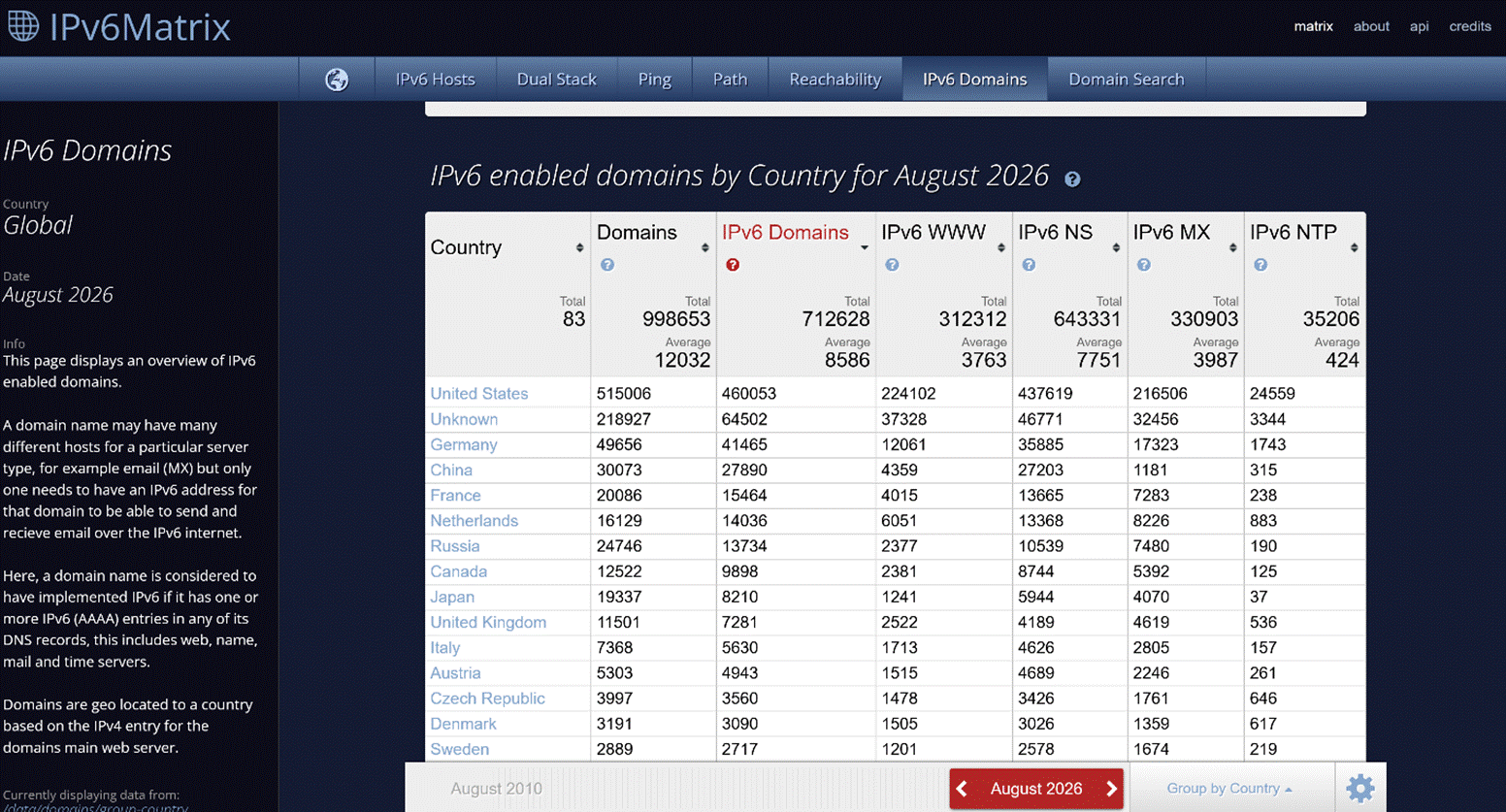
4. Domain-Level IPv6 Deployment (March 2026)
5. Protocol Performance (May 2026)
6. Centralisation of Internet Infrastructure.
1. Introduction
This article updates the May 2026 edition with data from the 3 August 2026 crawl published at ipv6matrix.org, and follows the series originating with the January 2022 article at silvermou.se/the-state-of-the-Internet-as-of-january-2022/.
The August 2026 crawl confirms the steady pace of IPv6 adoption. Dual-stack hosts now represent 54.27 % of the 5,340,321 crawled hosts — a further +0.50 percentage point gain since May 2026 and a cumulative +12.92 pp since January 2022. IPv4-only hosts have fallen to 45.73 %, their lowest recorded share in the crawler’s 16-year history.
The adoption rate has been consistent at approximately 0.5 pp per monthly crawl since the 50 % threshold was crossed in March 2025. At this pace, dual-stack hosts would surpass 60 % by late 2027.
Data sources for this edition:
| Dataset | Crawl Date Used | Notes |
| Dual-stack / hosts summary | 3 August 2026 | NEW — latest published crawl |
| Reachability (reach) | 27 May 2026 | Carried forward — no newer crawl published |
| Ping latency | 27 May 2026 | Carried forward |
| Traceroute path length | 27 May 2026 | Carried forward |
| Domains (WWW/NS/MX/NTP) | 11 March 2026 | Carried forward |
2. Website Host Records — August 2026
2.1 Protocol Distribution
The August 2026 crawl covered 5,340,321 total hosts. The distribution between dual-stack and IPv4-only is as follows:
| Protocol Configuration | Aug 2026 Count | Aug 2026 % | May 2026 % | Jan 2022 % |
| Dual-stack (IPv4 + IPv6) | 2,897,950 | 54.27 % | 53.77 % | 41.35 % |
| IPv4-only | 2,442,371 | 45.73 % | 46.23 % | 53.41 % |
| Total crawled hosts | 5,340,321 | 100 % | 100 % | 100 % |
Change since May 2026: +0.50 pp dual-stack, −0.50 pp IPv4-only.
Change since January 2022: +12.92 pp dual-stack, −7.68 pp IPv4-only.
2.2 Adoption Trajectory: 2010 – August 2026
The table below traces the full dual-stack adoption curve from the crawler’s launch to the latest August 2026 data point:
| Date | Total Hosts | Dual-Stack Hosts | Dual-Stack % | IPv4-Only % |
| Aug 2010 | 5,444,265 | 52,363 | 0.96 % | 99.04 % |
| Jan 2022 | 6,648,939 | 2,749,298 | 41.35 % | 53.42 % |
| Jan 2025 | 5,620,923 | 2,773,459 | 49.34 % | 50.66 % |
| Mar 2025 | 5,601,976 | 2,808,869 | 50.14 % | 49.86 % |
| May 2025 | 5,580,373 | 2,846,618 | 51.01 % | 48.99 % |
| Oct 2025 | 5,559,396 | 2,915,036 | 52.43 % | 47.57 % |
| Jan 2026 | 5,450,046 | 2,885,558 | 52.95 % | 47.05 % |
| Mar 2026 | 5,459,401 | 2,906,775 | 53.24 % | 46.76 % |
| May 2026 | 5,392,693 | 2,899,393 | 53.77 % | 46.23 % |
| Aug 2026 ◄ NEW | 5,340,321 | 2,897,950 | 54.27 % | 45.73 % |
The 50 % threshold was crossed in March 2025. Since then, the month-on-month rate has been steady: each crawl adds approximately half a percentage point to the dual-stack share, reflecting consistent CDN and hosting platform provisioning rather than episodic operator migration events.
2.3 IPv4-Only Hosts at Record Low
2,442,371 hosts (45.73 %) are now IPv4-only — the lowest share recorded since the crawler launched in August 2010, when 99.04 % of hosts were IPv4-only. The absolute count of IPv4-only hosts has fallen from 5,171,766 (Aug 2010) to 3,551,472 (Jan 2022) to 2,442,371 (Aug 2026), a reduction of more than 1.1 million since January 2022 alone.
3. Host Reachability (May 2026)
No new reachability crawl was published between May and August 2026. The May 2026 figures remain the most recent available.
Reachability data is drawn from the 27 May 2026 crawl. The crawler tests both HTTP and HTTPS on each IP address and marks a host as reachable if at least one responds.
| Protocol | Hosts with Records | Reachable Hosts | Reachability Rate | Change vs Jan 2022 |
| IPv4 | 4,397,483 | 3,917,411 | 89.08 % | ↑ from 89.61 % |
| IPv6 | 1,605,146 | 1,549,946 | 96.56 % | ↑ from 98.21 % |
IPv6 reachability (96.56 %) consistently outperforms IPv4 (89.08 %). This pattern has persisted across every crawl since at least 2017. IPv6 deployments tend to be deliberately provisioned on modern infrastructure; the broader IPv4 pool carries a legacy tail of misconfigured, abandoned, or over-provisioned addresses that drags down overall reachability rates.
Both IPv4 and IPv6 reachability have improved since January 2022 — IPv4 from 89.64 % to 89.08 % (marginal decline as the host count fell), IPv6 from 98.21 % to 96.56 % (a slight fall likely reflecting the rapid intake of new, not-yet-fully-configured AAAA entries).
4. Domain-Level IPv6 Deployment (March 2026)
The March 2026 crawl examined all 1,000,004 Majestic Million domains. 716,576 (71.66 %) had at least one IPv6-enabled service — up from 667,746 (66.77 %) in January 2022. The per-service breakdown is as follows:
| Service | Domains with IPv6 | Share of Top Million | Change vs Jan 2022 |
| Web (WWW) | 300,627 | 30.06 % | +6.92 pp from 23.14 % |
| Nameserver (NS) | 647,130 | 64.71 % | +3.83 pp from 60.88 % |
| Mail (MX) | 328,515 | 32.85 % | +12.92 pp from 19.93 % |
| Time (NTP) | 34,431 | 3.44 % | +1.89 pp from 1.55 % |
| Any IPv6 service | 716,576 | 71.66 % | +4.89 pp from 66.77 % |
Mail (MX) has seen the largest gain since January 2022 (+12.92 pp), driven by continued migration to Google Workspace and Microsoft 365. WWW coverage has nearly trebled (23.14 % → 30.06 %), reflecting CDN and hosting platform default enablement of AAAA records. NTP remains the laggard at 3.44 %, reflecting weak incentive to upgrade time infrastructure independently of the web stack.
4.1 Web (WWW) Records
300,627 domains (30.06 %) now have at least one IPv6-enabled web service, compared with 231,392 (23.14 %) in January 2022. This represents a near-trebling in four years. Growth was driven primarily by major hosting platforms and CDN providers (Cloudflare, Fastly, Akamai, Google Cloud) enabling AAAA records as part of their default provisioning, meaning customers on shared infrastructure gained IPv6 support without any deliberate action on their part.
4.2 Nameserver (NS) Records
647,130 domains (64.71 %) have at least one IPv6-accessible nameserver. DNS infrastructure has led the IPv6 transition for many years; nameservers for the top million domains are now predominantly dual-stack. The major managed DNS providers (Cloudflare, Route 53, Google Cloud DNS, NS1) have long offered IPv6 resolver addresses, and this is reflected in the near two-thirds coverage rate.
4.3 Mail (MX) Records
328,515 domains (32.85 %) have at least one IPv6-enabled mail server — the largest single jump of any service category since January 2022 (+12.92 percentage points). This growth is almost entirely attributable to the continued dominance of Google Workspace (Gmail) and Microsoft 365 (Outlook), both of which publish IPv6-capable MX records for all managed domains.
The January 2022 article noted that without Google, the share of domains with IPv6-accessible mail servers would have dropped from 27.08 % to 6.88 %. The structural dynamic has intensified rather than eased: as more organisations migrate from self-hosted mail to hosted platforms, the concentration of MX IPv6 coverage in the hands of two providers continues to grow.
4.4 Time (NTP) Records
34,431 domains (3.44 %) have IPv6-enabled NTP services — steady growth from 15,469 (1.55 %) in January 2022, but NTP remains a laggard. The incentive to upgrade time infrastructure is weak: NTP operates independently of the web stack, receives little direct end-user scrutiny, and most operators see no operational penalty for leaving NTP on IPv4-only.
5. Protocol Performance (May 2026)
5.1 Ping Latency
The May 2026 ping dataset covered 2,529,441 dual-stack hosts. Average latencies were:
| Protocol | Hosts Pinged | Total Ping Sum (ms) | Average Latency | Hosts with Lower IPv6 Latency |
| IPv4 | 2,529,441 | 842,330,483 | 333.0 ms | — |
| IPv6 | 2,529,441 | 237,292,142 | 93.8 ms | 308,646 (12.20 %) |
The aggregate IPv6 ping sum is approximately 28 % of the IPv4 sum for the same population of hosts (mean IPv6 latency 93.8 ms vs IPv4 333.0 ms). This dramatic difference is not primarily a property of the protocols themselves; it reflects the concentration of dual-stack IPv6 traffic through a small number of large, well-peered networks (Cloudflare, Google, Akamai, Fastly) whose PoPs are typically closer to end-users and whose IPv6 routing tables are more optimised than the broader IPv4 routing landscape.
It is important to note that only 12.2 % of dual-stack hosts showed IPv6 as the faster path. The mean advantage is driven by the distribution’s long tail: a relatively small number of hosts show very large IPv4 latency (often due to congested or circuitous IPv4 paths through large shared infrastructure), which pulls the IPv4 aggregate up substantially.
5.2 Traceroute Path Length (Hops)
The May 2026 traceroute dataset covered 660,633 dual-stack hosts:
| Protocol | Total Hops | Average Hops per Host | Hosts with Fewer IPv6 Hops | Hop Ratio (IPv6/IPv4) |
| IPv4 | 7,244,973 | 10.97 | — | — |
| IPv6 | 7,223,993 | 10.93 | 130,280 (19.72 %) | 0.9971 |
IPv4 and IPv6 hop counts are now nearly identical (hop ratio 0.9971, meaning IPv6 paths are 99.71 % the length of IPv4 paths on average). Only 19.72 % of dual-stack hosts showed shorter IPv6 paths. This represents a significant change from the pre-2014 era when IPv6 routing was substantially longer and more circuitous due to tunnelling and immature peering. IPv6 routing has now matured to near-parity with IPv4 for the top-million domains.
6. Centralisation of Internet Infrastructure
The January 2022 article devoted significant attention to the concentration of A, MX, and NS records among a small number of providers. This structural dynamic remains the dominant feature of the Internet as surveyed by the crawler — and has intensified.
Per the 2022 analysis:
- 31.71 % of all IPv4 hosts resolved to Cloudflare, Amazon, Confluence, or Google.
- 45.32 % of all MX records pointed to Google, and 36.3 % of domains had at least one MX record pointing to Google or Outlook.
- 40.23 % of all nameservers pointed to one of three providers — Cloudflare, Amazon, or Host Europe.
ASN-level provider breakdowns for the current crawl are not available through the summary API endpoints used in this analysis; they require access to raw crawl output. However, the structural trends are clear from the summary data:
- The continued growth of Cloudflare as a CDN and DNS provider means the share of web hosts behind Cloudflare has almost certainly increased. Cloudflare’s default provisioning now enables IPv6 for all customers, which is a primary driver of AAAA record growth.
- Google Workspace and Microsoft 365 now account for an even larger share of MX records than in 2022, given continued migration from self-hosted mail. The jump in MX IPv6 coverage (from 19.93 % to 32.85 %) is largely a proxy for market share growth at these two providers.
- Route 53 (Amazon) and Cloudflare together likely account for the majority of the nameserver IPv6 coverage increase.
The implication is that much of the measured IPv6 progress is provider-led rather than operator-led. Domain owners who have not actively configured IPv6 have acquired it by default through their CDN, DNS host, or email provider. This accelerates headline adoption rates while masking the true level of deliberate IPv6 deployment across the operator community.
7. Summary
The August 2026 crawl adds a further data point to a consistent adoption trend. The principal findings across all available data are:
- 54.27 % dual-stack (Aug 2026, NEW): 2,897,950 of 5,340,321 crawled hosts are dual-stack. +0.50 pp since May 2026, +12.92 pp since January 2022. The 50 % threshold was crossed in March 2025. The inversion from IPv4-dominant to dual-stack-dominant infrastructure took approximately 13 years from the start of the crawler in 2010.
- 45.73 % IPv4-only (record low): 2,442,371 hosts are IPv4-only — the lowest share in 16 years of crawl data, down from 99.04 % in August 2010 and 53.42 % in January 2022.
- IPv6 reachability leads IPv4 by 7.48 pp: 96.56 % IPv6 reachability vs 89.08 % IPv4 (May 2026). IPv6 infrastructure reliability consistently exceeds IPv4.
- 71.66 % of top million domains have IPv6 (Mar 2026): MX coverage has nearly doubled since 2022 (19.93 % → 32.85 %). WWW coverage has nearly trebled (23.14 % → 30.06 %).
- IPv6 latency advantage: Average IPv6 latency (93.8 ms) is approximately 28 % of average IPv4 latency (333.0 ms) for the same dual-stack host population, driven by CDN/hyperscaler routing optimisation over IPv6. IPv6 path lengths are now at near-parity with IPv4 (hop ratio 0.9971).
- Adoption is primarily provider-led: The dramatic improvement in IPv6 metrics since 2022 is largely attributable to a small number of hyperscalers and CDN providers enabling IPv6 by default. Cloudflare, Google, Amazon, and Microsoft account for a disproportionate share of all recorded IPv6 infrastructure. This concentration has accelerated headline adoption while raising questions about Internet resilience, governance, and the depth of genuine operator commitment to IPv6 beyond default platform provisioning.
- Projected 60 % by late 2027: At ~0.5 pp/crawl, dual-stack will reach 60 % around Q3–Q4 2027.